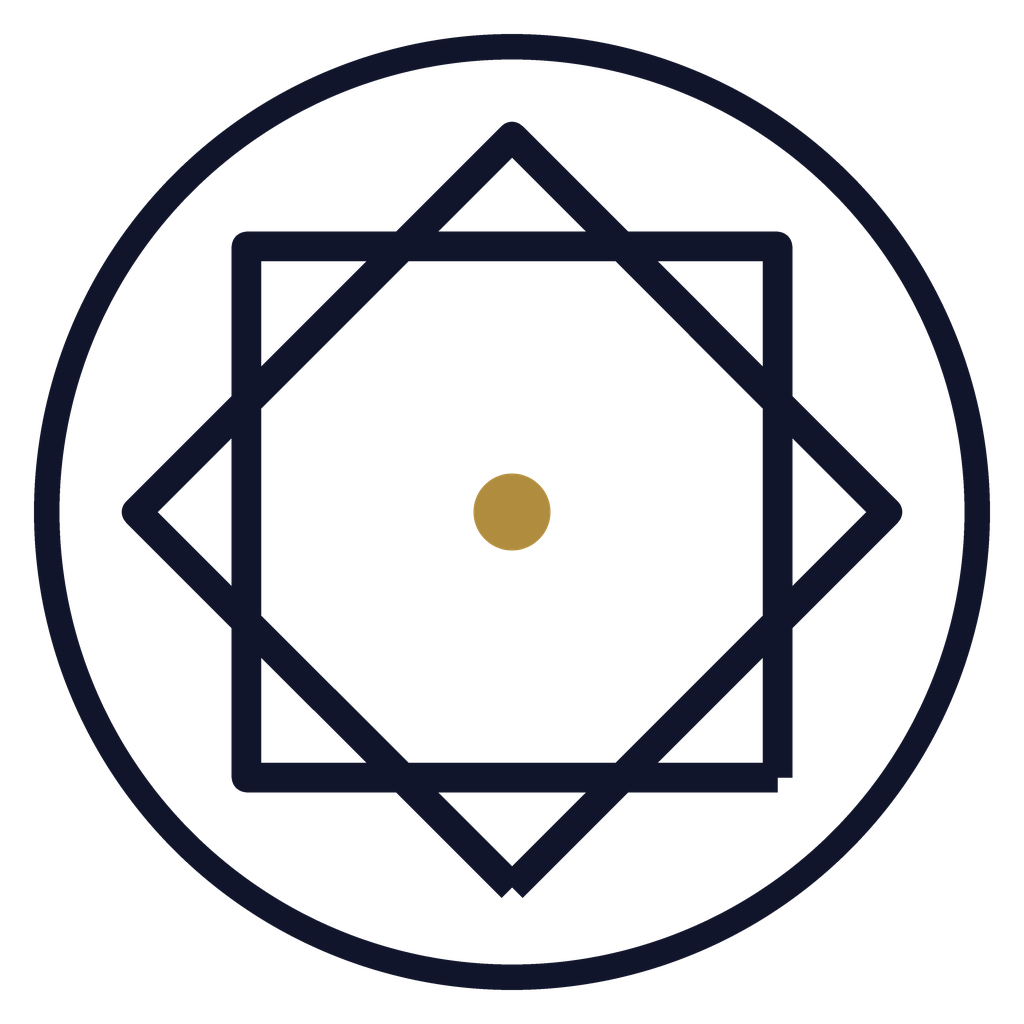
The Matrix of Destiny is a method of self-reflection that turns a single date of birth into a chart of numbers — and then reads that chart as a map of life themes. No name, no birth time, no birthplace: the date alone is the whole input.
Where it comes from
The method was introduced by the numerologist Natalia Ladini in 2006, and it has since spread through books, courses and free online calculators. It draws on older esoteric traditions — the twenty-two Major Arcana of the tarot, the seven chakras, numerology — but arranges them into its own original system: an eight-pointed star, called the octagram, inside which the numbers of a birth date are reduced, combined and positioned.
The core idea
The premise is simple to state and worth treating with care: the numbers hidden in your birth date correspond to themes, talents and recurring lessons in your life. Each birth date produces a unique constellation of numbers between 1 and 22, and each number maps to one of the 22 Major Arcana — archetypal figures like The Magician, Justice or The Star that give the number a character to reflect on.
The octagram
The chart itself is an eight-pointed star. Your day of birth sits at the left point, the month at the top, the year at the right — each reduced to a number from 1 to 22. Those three give rise to a bottom point and then a centre number, the “comfort zone”, which the method treats as the core of the whole chart. Further points are derived by adding neighbouring positions together and reducing again, until the star is filled: the corners of a second, straight square (connected with family and lineage), a vertical channel of talents, and rows of positions for love, money and purpose.
What a reading covers
- The centre — your comfort zone: the energy the method associates with your core.
- The karmic tail — a three-number sequence at the base of the chart, linked to unfinished business and recurring patterns.
- The love line and the money line — diagonals associated with relationships and material life.
- The family square — corners connected to the father and mother lines.
- The purposes — sky and earth lines, personal, social, spiritual and planetary purposes: tasks the method associates with different phases of life.
- The 22 arcana — every position carries one; their meanings give the numbers their interpretive flavour.
What it is — and what it is not
The Matrix of Destiny is best understood as a structured mirror: it gives you language for thinking about patterns you may already sense in your life. It is not a science, and none of its claims have been scientifically validated. It cannot diagnose illness, predict the future, fix a relationship, or tell you what career to choose. Charts are interesting because they invite reflection — they become harmful when they are treated as authority over real decisions.
We publish the calculation rules openly so you can check our work, we mark interpretations as provisional, and we tell you plainly where the method’s own documentation is uncertain.
Not astrology, not a tarot reading
It helps to say what the method is not. It is not astrology: there are no planets, houses or transits — only the arithmetic of a birth date. It is not a tarot reading either: no cards are drawn and nothing is random; the same birth date always produces the same chart. And unlike many numerology systems, it does not reduce everything to a single “life path” number — it builds a whole geometry of positions that are meant to be read together. On this site the calculation rules are published openly and the calculator is free, so you can move between the theory and your own chart at every step.
Common misunderstandings
- “My name changes my chart.” It does not. The method uses the birth date alone; two people born on the same day receive the same chart. Names in our calculator are an optional label only.
- “A ‘bad’ number means a bad life.” No position is good or bad in itself. In the method’s own framing, every arcana carries both a light and a shadow side — the same number can describe a strength used well or a pattern used badly.
- “The chart tells me what will happen.” It does not predict events. Practitioners describe it as a map of themes and tendencies — useful for reflection, useless as a forecast.
- “I need an expert to read it.” The calculation is mechanical and checkable, and our guides walk you through the reading step by step. Experts may add perspective, but no secret knowledge is required to begin.
What you need to begin
Nothing but a birth date — and, if you like, our free tools.